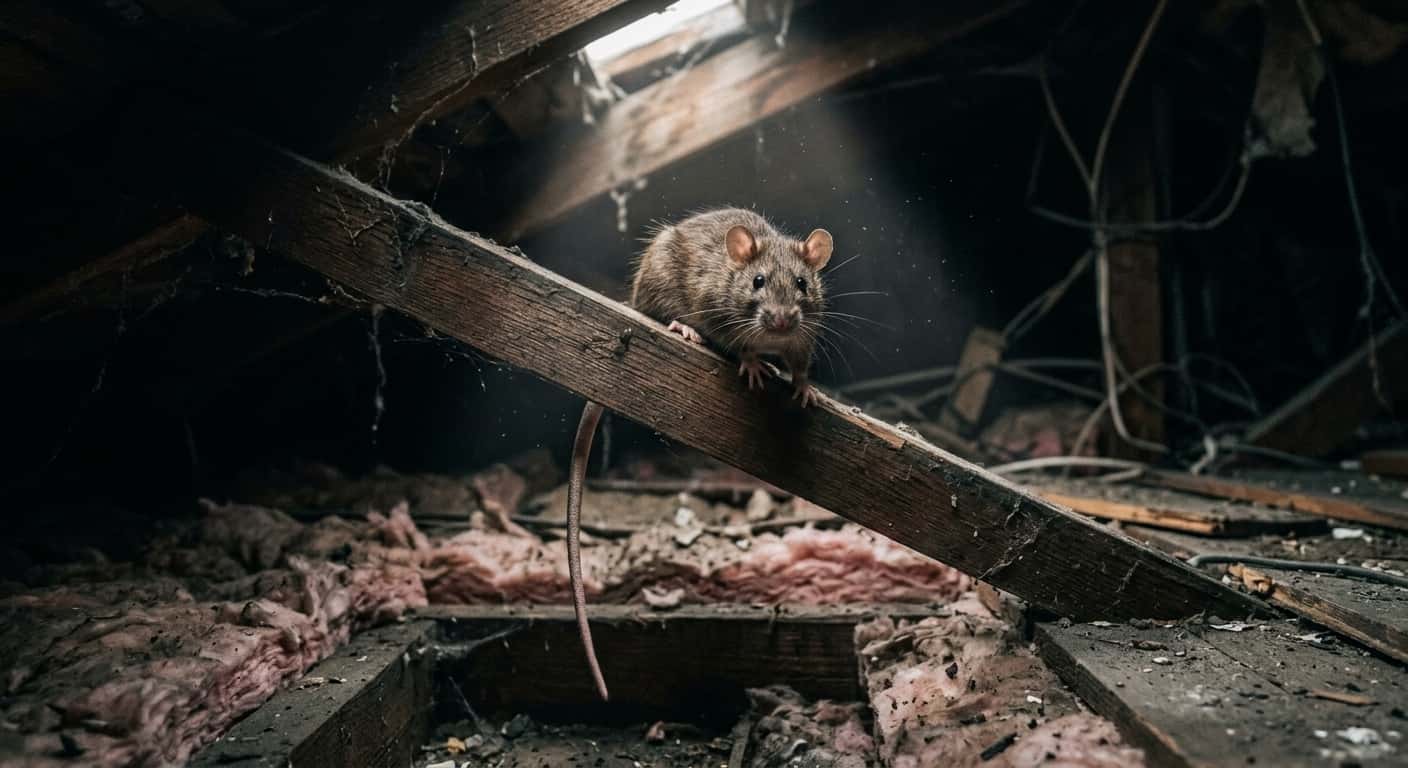
That scratching sound you hear at 2 a.m. isn’t your imagination. If you’re a Florida homeowner hearing noises overhead at night, there’s a strong chance you’re sharing your attic with roof rats, the most common and destructive rodent species in the state.
Rodents invade approximately 21 million U.S. homes each winter, and they’re estimated to cause 20-25% of all house fires of unknown origin through electrical wire damage. In Florida, roof rats dominate. Our warm climate, abundant fruit trees, and elevated building styles create ideal conditions for a rodent that prefers to live above ground level.
This isn’t a problem that resolves itself. A single female roof rat can produce up to 40 pups in her lifetime, and she reaches breeding age in just a few months. Two rats in your attic today can become a colony by next season. Below: how to identify the problem, understand the damage, and stop it.
Key Takeaways
- Roof rats can squeeze through openings as narrow as a quarter and prefer attics, ceilings, and upper floors
- Rodents cause an estimated 20-25% of all house fires of unknown origin by chewing electrical wiring
- A single female produces up to 40 pups, meaning two rats become dozens within months
- Roof rats transmit leptospirosis, rat-bite fever, and murine typhus to humans and pets
What Do Roof Rats Look Like, and Why Are They Florida’s Worst Rodent?
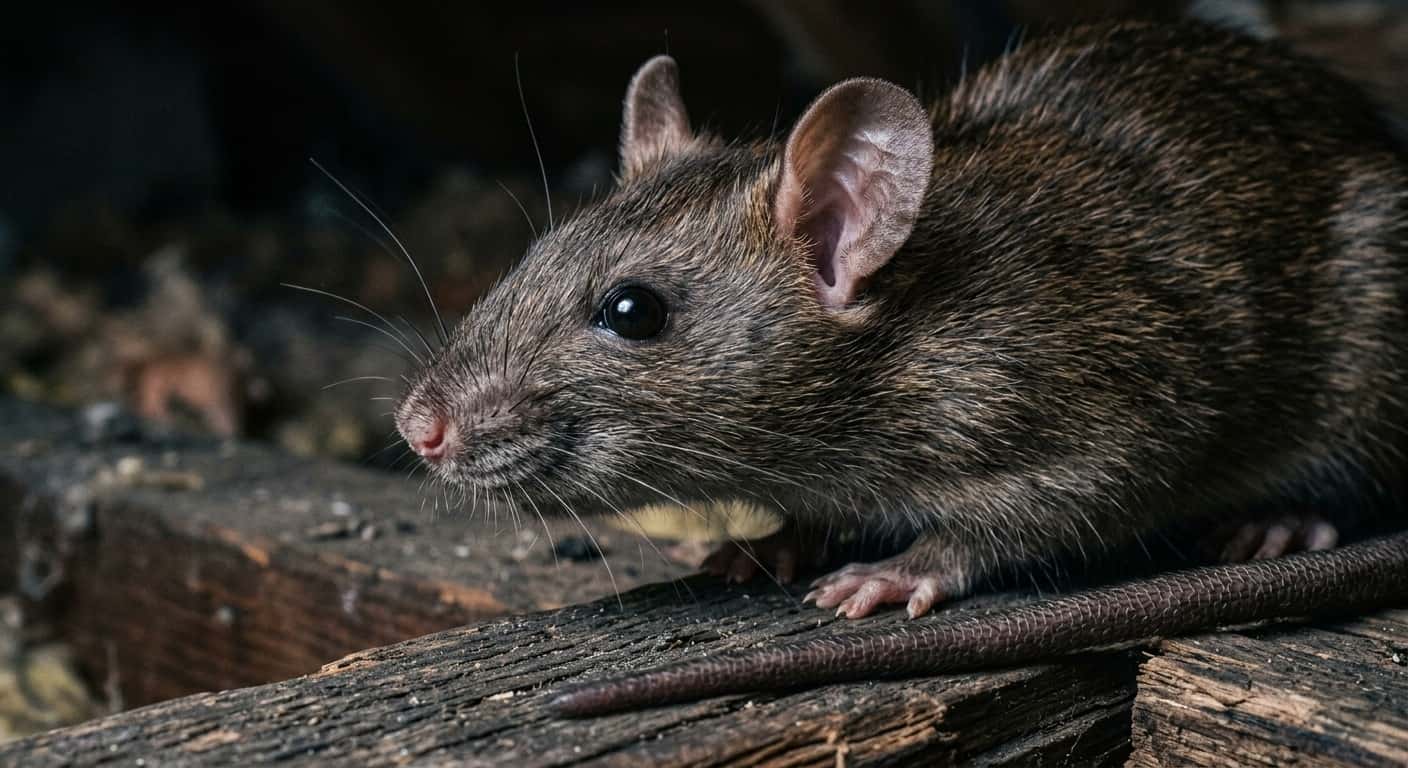
Roof rats (Rattus rattus) measure 12-14 inches from nose to tail tip, with a tail that’s actually longer than the body, a key identification feature that separates them from every other rat species in Florida. They weigh 5-10 ounces and display three color patterns in Florida: gray back with lighter underside, solid black, or brownish-gray with a white belly.
Why are they worse than Norway rats for Florida homeowners? The answer is behavior. Roof rats climb. They scale brick walls, run along power lines, tightrope-walk across fences, and use tree branches as bridges to reach your roofline. Norway rats burrow underground and typically invade basements or ground-level spaces. Roof rats go up, into your attic, ceiling voids, and wall cavities.
Unlike Norway rats, which nest in ground burrows near foundations, roof rats establish colonies in elevated, secluded spaces like attics, ceilings, and wall voids. This climbing behavior makes Florida homes, with their tile roofs, exposed soffits, and abundant landscaping, particularly vulnerable to roof rat infestations.
Quick Identification: Roof Rat vs. Norway Rat
| Feature | Roof Rat | Norway Rat |
|---|---|---|
| Size | 12-14 inches total | Up to 16 inches total |
| Tail | Longer than body, hairless, dark | Shorter than body, thicker |
| Snout | Pointed, elongated | Blunt, rounded |
| Ears | Large relative to body | Small relative to body |
| Droppings | Spindle-shaped, ½ inch, pointed ends | Capsule-shaped, ¾ inch, blunt ends |
| Nesting | Attics, rooflines, trees | Burrows, basements, ground level |
| Climbing | Excellent climber | Poor climber |
If you suspect rodent activity, review the top 5 signs of a rodent infestation to confirm what you’re dealing with.
What Are the Signs of Roof Rats in Your Attic?
Roof rats are nocturnal, so you’ll rarely see them during the day. Ants leave visible trails. Cockroaches scatter when you flip on a light. Roof rats hide overhead and come out after dark. That means you need to recognize the indirect signs.
Sounds
The most common first sign is noise. Scratching, scurrying, and gnawing sounds in the ceiling or walls at night, especially between dusk and dawn, almost always indicate rodent activity. Roof rats are active runners. You’ll hear them moving across ceiling joists and through wall voids.
Droppings
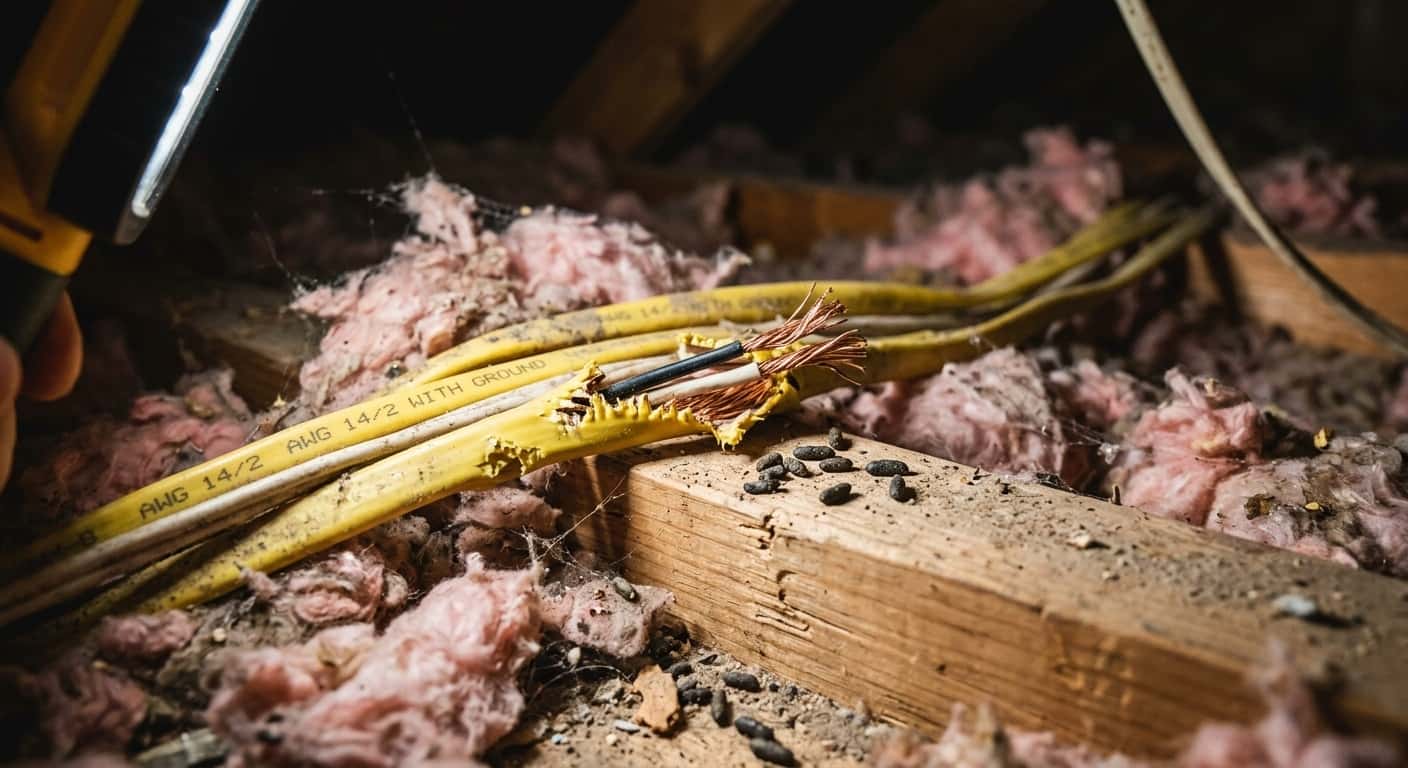
Roof rat droppings are shiny, black, approximately half an inch long with pointed ends. You’ll find them along travel paths, near walls, in attic corners, around stored boxes, and near entry points. Fresh droppings are dark and moist. Old droppings are dry and crumble when pressed.
How many droppings signal a real problem? A single rat produces 40-50 droppings per day. If you’re finding more than a scattered few, you likely have multiple rats.
Gnaw Marks and Damage
Roof rats must gnaw constantly to keep their ever-growing incisors trimmed. Look for tooth marks on:
- Electrical wiring insulation (the most dangerous sign, exposed wires cause fires)
- Wooden beams, joists, and stored furniture
- Cardboard boxes and plastic storage containers
- PVC plumbing pipes
- HVAC ductwork and insulation
Grease Marks
Rats follow the same paths repeatedly. Their oily fur leaves dark, greasy rub marks along walls, rafters, and the edges of entry holes. These marks build up over time and are a reliable indicator of established travel routes.
Nesting Material
Roof rats shred insulation, cardboard, fabric, and paper to build nests. If you notice torn-up insulation or piles of shredded material in your attic, a colony has likely established itself.
What we find during inspections: In Tampa Bay homes, the #1 overlooked sign of roof rats isn’t in the attic. It’s on the roof itself. Our technicians look for gnaw marks on soffit vent screens, grease stains around gutter line gaps, and chewed edges on roof flashing. By the time homeowners hear scratching overhead, the rats have usually been entering for weeks through an exterior gap they’ve widened over time.
How Much Damage Can Roof Rats Actually Cause?
The damage is where things get serious fast. Roof rats cause structural, electrical, and health damage that goes well beyond nuisance.
Electrical and Fire Risk
Rodents are estimated to be responsible for 20-25% of all house fires of unknown cause in the United States because of their habit of chewing through electrical wiring. When a roof rat strips insulation from a wire in your attic, the exposed metal generates heat. That exposed wire sitting against wood framing or fiberglass insulation creates an ignition source.
This isn’t a theoretical risk. It causes millions of dollars in structure damage annually across the country. And most homeowners insurance policies exclude coverage for rodent damage, though fires caused by rodent-chewed wires are typically covered if the rodent problem wasn’t already known.
Insulation and HVAC Damage
Roof rats tear apart insulation to build nests, reducing your attic’s thermal efficiency and increasing energy costs. They also chew holes in air ducts, causing conditioned air to leak into the attic rather than reaching living spaces. In Florida, where air conditioning runs 8-10 months per year, HVAC duct damage translates directly to higher electricity bills.
Health Risks
Roof rats transmit at least three serious diseases to humans:
- Leptospirosis. A bacterial infection spread through rat urine that can contaminate water and food sources. Symptoms range from mild flu-like illness to severe kidney and liver failure.
- Rat-bite fever. Transmitted through bites, scratches, or contact with contaminated surfaces. Causes fever, rash, and joint pain.
- Murine typhus. Spread by fleas that feed on infected rats and then bite humans. Florida reports cases of murine typhus annually, primarily in areas with established roof rat populations.
Rat droppings and urine also contaminate attic insulation. When your HVAC system draws air through a rat-contaminated attic, it can circulate allergens and pathogens into your living space.
How Are Roof Rats Getting Into Your Attic?
Roof rats can squeeze through openings as narrow as a quarter, roughly half an inch in diameter. Smaller than most homeowners realize. Here are the most common entry points in Florida homes.
According to the CDC, sealing openings of a quarter-inch or larger with steel wool reinforced by caulk or cement is the most effective long-term rodent exclusion method. For roof rats specifically, this exclusion work must extend to every elevated opening on the home, not just ground-level gaps.
Roof-Level Entry Points
- Gaps in roof tiles or shingles. Cracked, shifted, or missing tiles create gaps that rats widen over time
- Soffit and fascia openings. Damaged or poorly fitted soffit panels leave gaps directly into the attic
- Roof vent covers. Plastic or aluminum vent covers corrode or crack, creating access points
- Plumbing vent pipes. The gap around roof-penetrating pipes is a classic entry point
- Ridge vents. Improperly sealed ridge vents allow access along the entire roofline
Mid-Level Entry Points
- Gable vents. The mesh screening behind gable vents corrodes or tears over time
- Utility line penetrations. Cable, phone, and electrical lines entering the house create gaps where they penetrate walls
- Gaps where walls meet the roofline. Construction joints between wall plates and roof framing often have unsealed gaps
- AC line penetrations. The hole cut for refrigerant lines is frequently oversized and poorly sealed
How They Reach the Roof
Most Florida homeowners overlook the access routes. Even if your roof is perfectly sealed, rats can’t exploit entry points they can’t reach. Their access routes include:
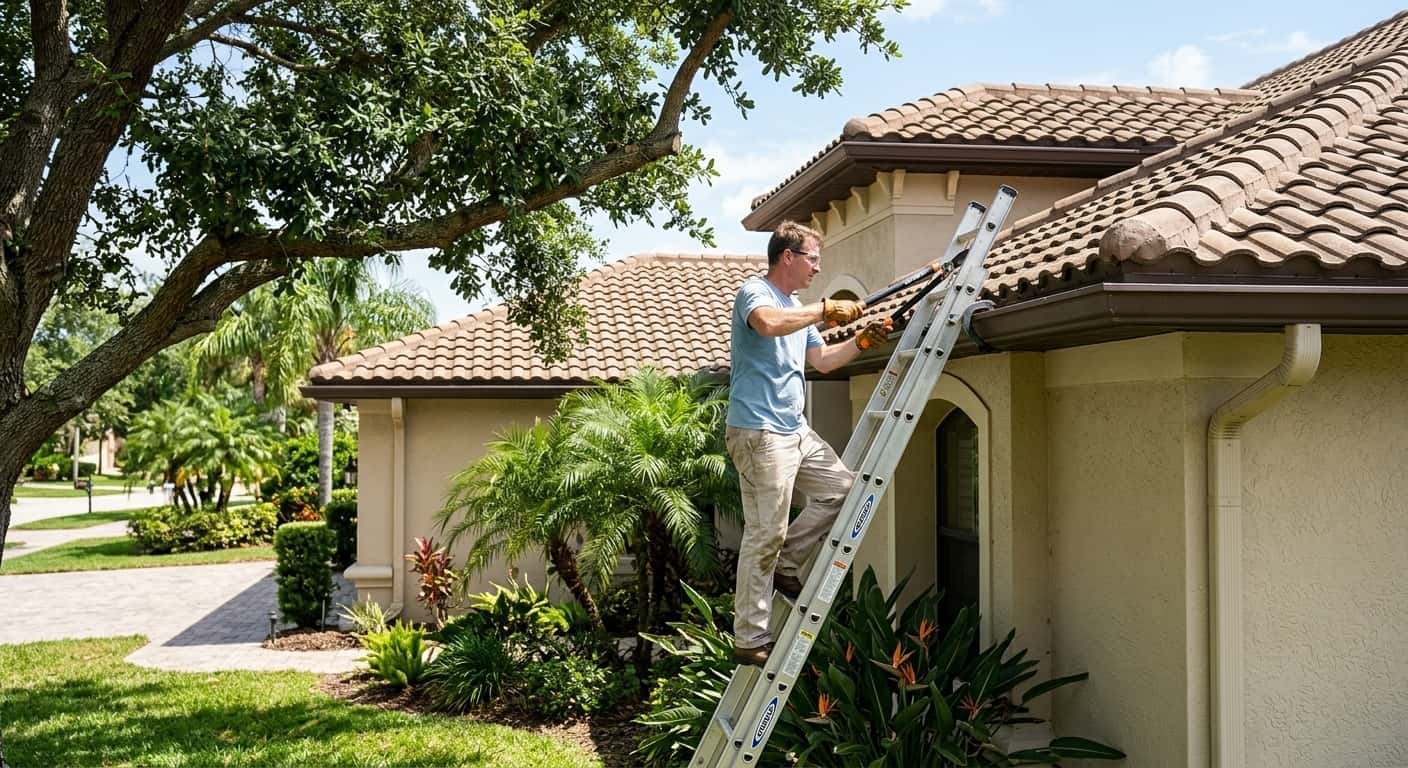
- Tree branches. Any branch within 3 feet of your roofline is a highway. Roof rats are nimble enough to jump that distance.
- Power and cable lines. Rats routinely travel along utility lines from poles to homes
- Fence lines. Privacy fences adjacent to the house provide easy climbing routes
- Dense vegetation. Ivy, bougainvillea, and other climbing plants growing on exterior walls provide direct vertical access
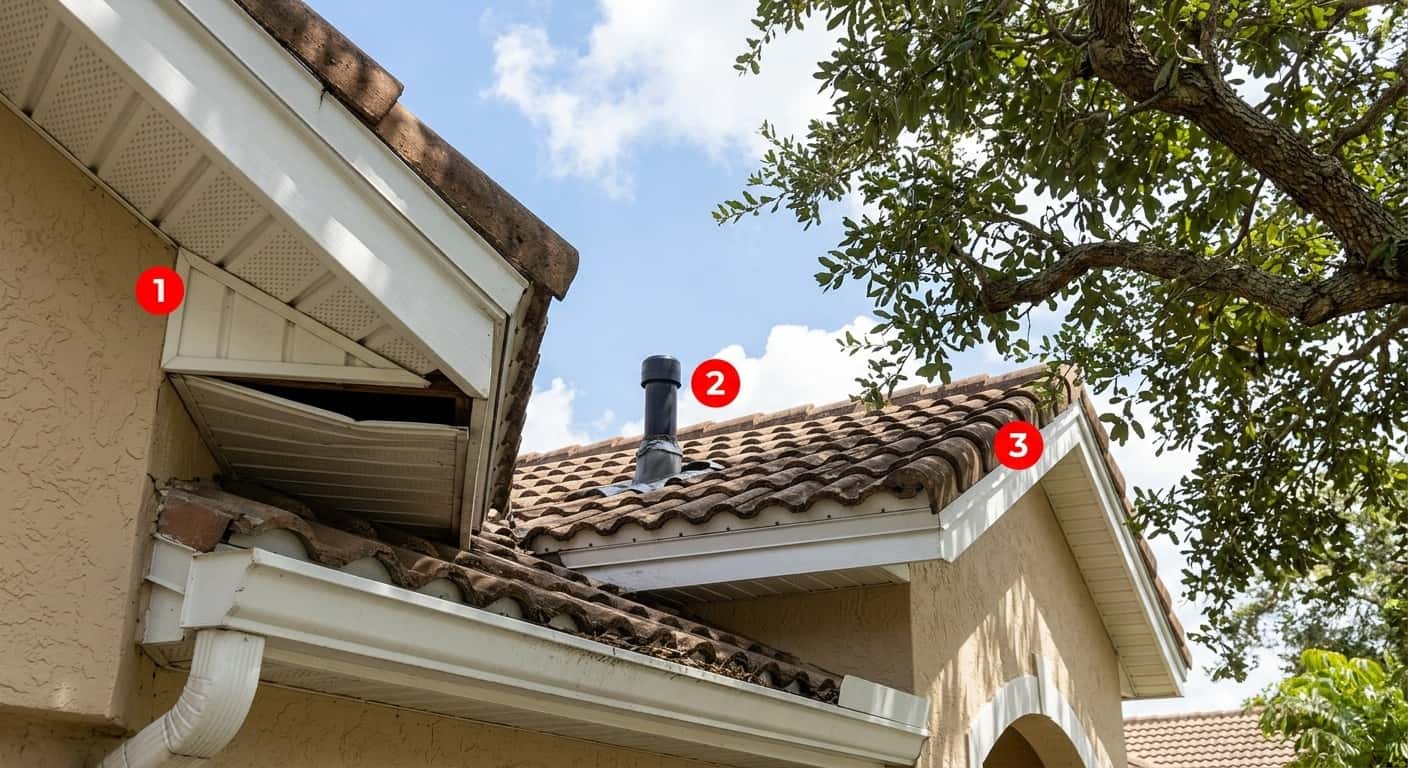
Storm damage is another major contributor to new entry points. Learn more in our guide on hurricane season pest problems in Tampa Bay and how roof damage invites rodents.
How Do You Get Rid of Roof Rats in Your Attic?
If you’ve confirmed signs of roof rats, the response has three phases: trapping, exclusion, and sanitation. Skipping any phase guarantees the problem returns.
Phase 1: Professional Trapping
Roof rats exhibit neophobia, a strong avoidance of new objects in their environment. This makes DIY trapping unreliable because rats will often refuse to go near unfamiliar traps for days or even weeks, giving the colony more time to grow. A professional understands proper trap placement along established travel routes (identified by grease marks and droppings patterns) and monitors traps on a systematic schedule to ensure the population is being reduced efficiently.
Why not poison? Rodenticide has its place, but in attic settings it creates a secondary problem. A poisoned rat that dies inside a wall void or above a ceiling produces an intense odor that can last weeks. Liberty Pest Management uses rodenticide strategically in exterior bait stations to reduce the incoming population, not inside the attic.
Phase 2: Exclusion (The Critical Step)
Trapping without exclusion is pointless. You’ll catch the current rats while new ones enter through the same gaps. Exclusion means sealing every opening of half an inch or larger on your home’s exterior.
Exclusion means inspecting every linear foot of your roofline, which means ladder access to soffits, ridge vents, plumbing penetrations, and flashing gaps. A single missed opening means the rats return. Professional exclusion has a dramatically higher success rate than DIY attempts.
Phase 3: Sanitation and Repair
After removal and exclusion, contaminated insulation must be removed, surfaces disinfected, damaged wiring inspected by a licensed electrician, and ductwork repaired. This phase protects your family’s health and restores your attic’s function.
Why exclusion fails without a professional eye: Homeowners typically seal the obvious gaps they can see from ground level. Roof rats enter through gaps you need a ladder and a flashlight to find, under ridge caps, behind loose flashing, around deteriorated pipe boots, and through corroded soffit screens. A thorough exclusion inspection means checking every linear foot of your roofline and every penetration. Missing a single half-inch gap means the rats come back.
If you’re unsure whether your situation calls for professional help, review our guide on when to call an exterminator for the key warning signs.
How Do You Prevent Roof Rats From Coming Back?
Prevention is ongoing, not one-and-done. This maintenance routine keeps roof rats out permanently.
Landscaping Management
- Trim all tree branches to at least 3 feet from your roofline. The single most important prevention step. Do it quarterly in Florida, where trees grow year-round.
- Remove fruit from the ground. Citrus trees, palm fruit, and avocados are roof rat magnets. Pick up fallen fruit daily during season.
- Thin dense vegetation near exterior walls. Ivy, jasmine, and bougainvillea growing on walls provide climbing routes
- Keep shrubs trimmed away from the house. Maintain a 12-inch gap between vegetation and your foundation
Food Source Elimination
- Store pet food in sealed metal or heavy plastic containers. Never leave it out overnight
- Use bird feeders with catch trays, or remove feeders entirely if you have an active rat problem
- Secure garbage in bins with tight-fitting lids
- Clean up grill areas after cooking. Grease and food scraps attract rodents
- Pick ripe fruit from citrus trees promptly
Ongoing Monitoring
- Inspect your attic quarterly with a flashlight. Look for fresh droppings, new gnaw marks, and nesting material
- Check exterior entry points annually, especially after storm season
- Listen for nighttime sounds. Catching re-entry early prevents re-infestation
- Consider professional monitoring with exterior bait stations around your property perimeter
When Should You Call a Professional for Roof Rats?
Rats are smarter and more cautious than most pests. They avoid new objects in their environment (a behavior called neophobia), which means DIY trapping often fails because rats simply avoid unfamiliar traps for days or weeks. The CDC reports that rats and mice spread more than 35 diseases worldwide, making delayed treatment a real health risk.
Call Liberty Pest Management if:
- You’ve heard scratching sounds for more than a few days. The colony is established
- You find droppings in multiple locations. This indicates multiple rats and established travel routes
- DIY traps aren’t catching anything after a week. The rats may be avoiding them
- You see gnaw marks on wiring. An immediate fire hazard that needs professional assessment
- You can’t identify or access the entry points. Roof-level exclusion takes specialized equipment and experience
- You have pets or small children. Professional-grade exclusion and treatment is safer than DIY methods with exposed traps
Liberty Pest Management handles the full cycle: inspection to identify entry points and colony size, trapping to remove the current population, exclusion to seal every gap, and sanitation guidance to restore your attic. We are licensed by the Florida Department of Agriculture (JB-151032).
See our full pest control services to learn how Liberty Pest Management handles rodent removal and exclusion.
Frequently Asked Questions
How fast do roof rats multiply in Florida?
A single female roof rat can produce up to 40 pups in her lifetime, with litters of 5-8 pups every few months. Florida’s warm climate means roof rats breed year-round rather than seasonally. Two rats entering your attic in January can become a colony of 10 or more by spring.
What time of year are roof rats worst in Florida?
Roof rats are most active during fall and winter when they seek indoor warmth and shelter, but Florida’s mild climate means they’re a year-round problem. Activity increases from August through February, with peak calls to pest control companies occurring in October and November as rats settle in for the cooler months.
Can roof rats chew through concrete or metal?
Roof rats can gnaw through wood, plastic, aluminum, drywall, and even soft metals like lead. They can’t chew through steel, concrete, or hardware cloth, which is why the CDC recommends steel wool reinforced with caulk or cement for sealing entry points. Avoid using expanding foam alone. Rats chew through it easily.
Do ultrasonic repellers work against roof rats?
No. Multiple independent studies have found ultrasonic pest repellers to be ineffective against rodents. Rats may initially startle at the sound but habituate to it within days. The Federal Trade Commission has warned several manufacturers about unsubstantiated claims regarding ultrasonic pest devices. Your money is better spent on exclusion materials and professional trapping.
How much does roof rat removal cost in Florida?
Roof rat removal costs depend on the number of entry points, the extent of the infestation, and whether insulation or wiring damage needs repair. Early intervention is significantly less expensive than waiting. An untreated infestation can lead to costly attic rewiring, insulation replacement, and structural repairs that far exceed the cost of professional trapping and exclusion. Contact Liberty Pest Management for a free inspection and estimate.
Don’t Wait, Roof Rats Get Worse Every Week You Delay
Roof rats are the most persistent rodent problem in Florida, and they won’t leave on their own. Every week you delay gives them time to breed, chew through more wiring, contaminate more insulation, and establish deeper into your home’s structure.
Act now:
- Inspect your attic tonight with a flashlight. Look for droppings, gnaw marks, and nesting material
- Walk your roofline from ground level. Check for damaged soffits, lifted vents, and gaps
- Trim tree branches back to at least 3 feet from your roof
- Remove fallen fruit and secure outdoor food sources
- Call a licensed professional if you find any evidence of rodent activity
The sooner you act, the smaller the problem and the lower the cost. A two-rat problem is a quick fix. A twenty-rat colony is a renovation project.
Schedule your free inspection with Liberty Pest Management and get roof rats out of your attic for good.
Liberty Pest Management serves the Tampa Bay area including Odessa, Trinity, Land O’ Lakes, Wesley Chapel, and surrounding Pasco County communities. Licensed by the Florida Department of Agriculture (JB-151032). Call us at 813-961-2627 or get a free quote today.